
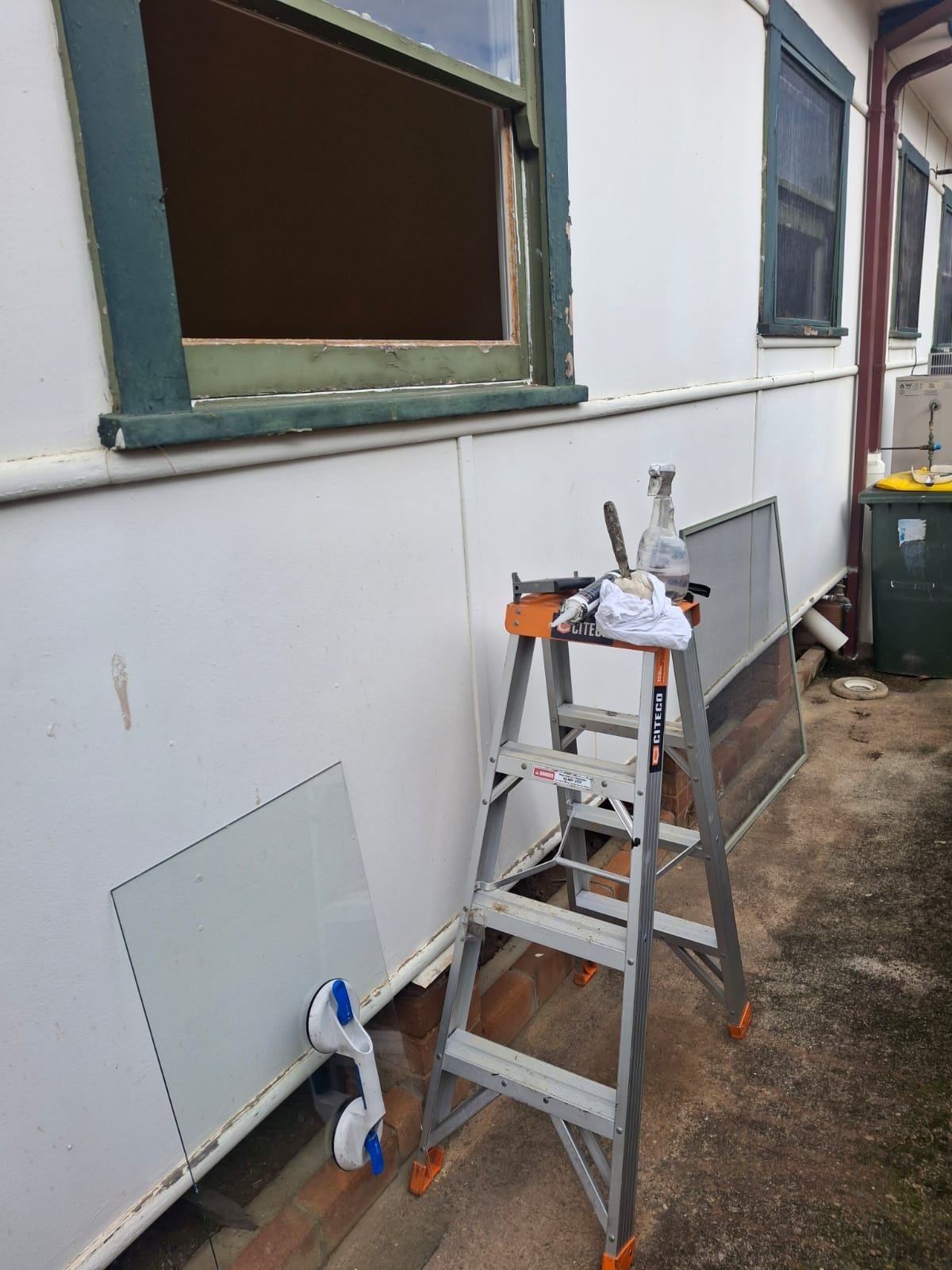
Does my window need safety glass?
Glass in a door, beside a door, close to the floor or anywhere in a bathroom needs to be safety glass, and that holds for the replacement pane even when the original was not.
If a pane sits in a door, right beside a door, low down in the wall, or anywhere in a bathroom, it needs to be safety glass. That applies whether the house went up last year or sixty years ago: when glass in one of those positions is replaced, the new pane is expected to meet the current standard, even if the piece that came out was ordinary float glass. Everywhere else it depends on how big the pane is and where it sits. Here is how to work out which group your window is in.
What counts as safety glass
Safety glass is not a brand or a thickness. It describes how a pane behaves when something hits it, and two types qualify.
Toughened glass, also called tempered, is heated and cooled quickly so the surfaces are held in compression. When it fails it fails all at once, breaking into small blunt granules instead of long shards, and the opening is left empty.
Laminated glass is two or more sheets bonded to a clear plastic interlayer. It cracks but holds together, because the pieces stay stuck to the interlayer and the pane generally stays in the frame.
Ordinary annealed float glass does neither. It breaks into large pieces with long edges, which is why it is not acceptable where someone can walk into it or put a hand through it. The safety glass we install meets AS/NZS 2208, and we glaze to AS 1288.
Where a home needs safety glass
The National Construction Code requires glass used in a house to be a type within the scope of AS 1288, and sets separate requirements for glazing in areas where the potential for human impact could occur (see the NCC Housing Provisions on glass). In an ordinary house that catches:
- Glass in doors. A front or back door, a sliding or stacker door, a glazed internal door.
- Panels beside a door. A fixed sidelight or narrow panel near the door opening, where someone reaching for the handle could put a hand through it.
- Glazing close to floor level. A window whose lowest edge sits low in the wall, which people walk into far more often than you would expect.
- Everything in a bathroom or ensuite, including shower doors, shower screens and bath enclosures.
- Glass in a barrier. A balustrade, or a window doing the job of a barrier where there is a drop behind it.
The standard sets the actual thresholds: how low is low, how close to the door counts as beside it, and what grade and thickness suit the size of the pane. Those depend on the opening, its exposure and what the glass is doing, so a glazier can confirm what the standard requires for your window rather than you working it out from a table.
Toughened or laminated
Both are safety glass, so the real question is usually not whether a pane is safe but which failure mode suits the opening.
Toughened is the one that can be frameless, and the one to use where the panel needs holes, notches or polished edges: a frameless shower panel, a glass door, a balustrade. The trade-off is that it is cut and finished to final size and toughened after, so it cannot be cut or drilled later, and when it goes the opening is completely open.
Laminated keeps the hole closed. A cracked laminated pane is still a barrier and still a weather seal, which matters upstairs, in a shopfront, in a balustrade, and in any opening you could not board up quickly. It is also the better choice where security or street noise is the concern. The trade-off is weight and thickness.
For plenty of jobs either will do. For frameless shower screens it is toughened; for barriers and for glass you would not want to lose entirely, laminated earns its place.
How to tell what is already in your window
Safety glass is marked. Look along the corners of the pane for a small permanent stamp, usually sandblasted or printed, naming the maker and the standard it was made to. It is easy to miss, and often hidden under the bead or the frame, so a torch at eye level helps.
If you cannot find a mark, do not take that as proof either way: it may simply be covered, and older glass was not always marked the way current glass is. The reverse is reliable enough, in that a mark naming a safety glazing standard means the pane is safety glass.
What to do if you think a pane is wrong
- Leave it alone. Do not tap, press or flex the glass to find out what it is. If it is the wrong glass, that is the worst way to discover it.
- Note where it is. Which room, and whether the pane is in a door, beside a door, low in the wall, in a wet area or in a barrier.
- Measure it roughly. Height and width in millimetres. Size matters, because a larger pane in the same position needs more from the glass.
- Check each corner for a stamp, and write down which panes have one and which do not.
- Get it looked at. We measure on site and put the figures in a written quote, free within our service area, and the written quote is the price you pay.
Common questions
Does old glass have to be upgraded?
There is generally no expectation that you replace sound glass simply because it predates the current standard. What changes things is replacement: new glass going into one of the positions above is expected to meet the current standard. If you are renovating or altering an opening, a glazier or your builder can confirm what applies.
Is toughened glass stronger than ordinary glass?
It is considerably more resistant to impact and heat stress, but it is not unbreakable, and strength is not why it is called safety glass; the break pattern is. Toughened glass is most vulnerable at its edges and corners, so a knock to an exposed edge can take out a whole panel that looked fine.
Can I get safety glass cut to size and fit it myself?
Annealed and laminated glass can be cut to size. Toughened cannot be cut, drilled or edge-worked once it has been toughened, so it has to be made to its final size from the start. We cut glass and mirror to size for collection from the Minchinbury workshop as supply only. Whether fitting it yourself is sensible depends on where it goes; glass in doors, bathrooms and barriers is a job for a glazier.
Do shower screens have to be safety glass?
Yes. All glazing in a bathroom or ensuite falls in the human impact category, shower doors, screens and bath enclosures included, which is why shower screens are made from toughened safety glass rather than ordinary glass.
Not sure what your glass is?
All Purpose Glass is a family-owned glazier working from our own workshop in Minchinbury since 1992. We measure, make and install replacement glass across Western Sydney, including sliding door glass, and we work across the Blacktown, Parramatta, Penrith and Fairfield areas, including Marsden Park. Tell us where the pane sits and we will tell you what it needs.