
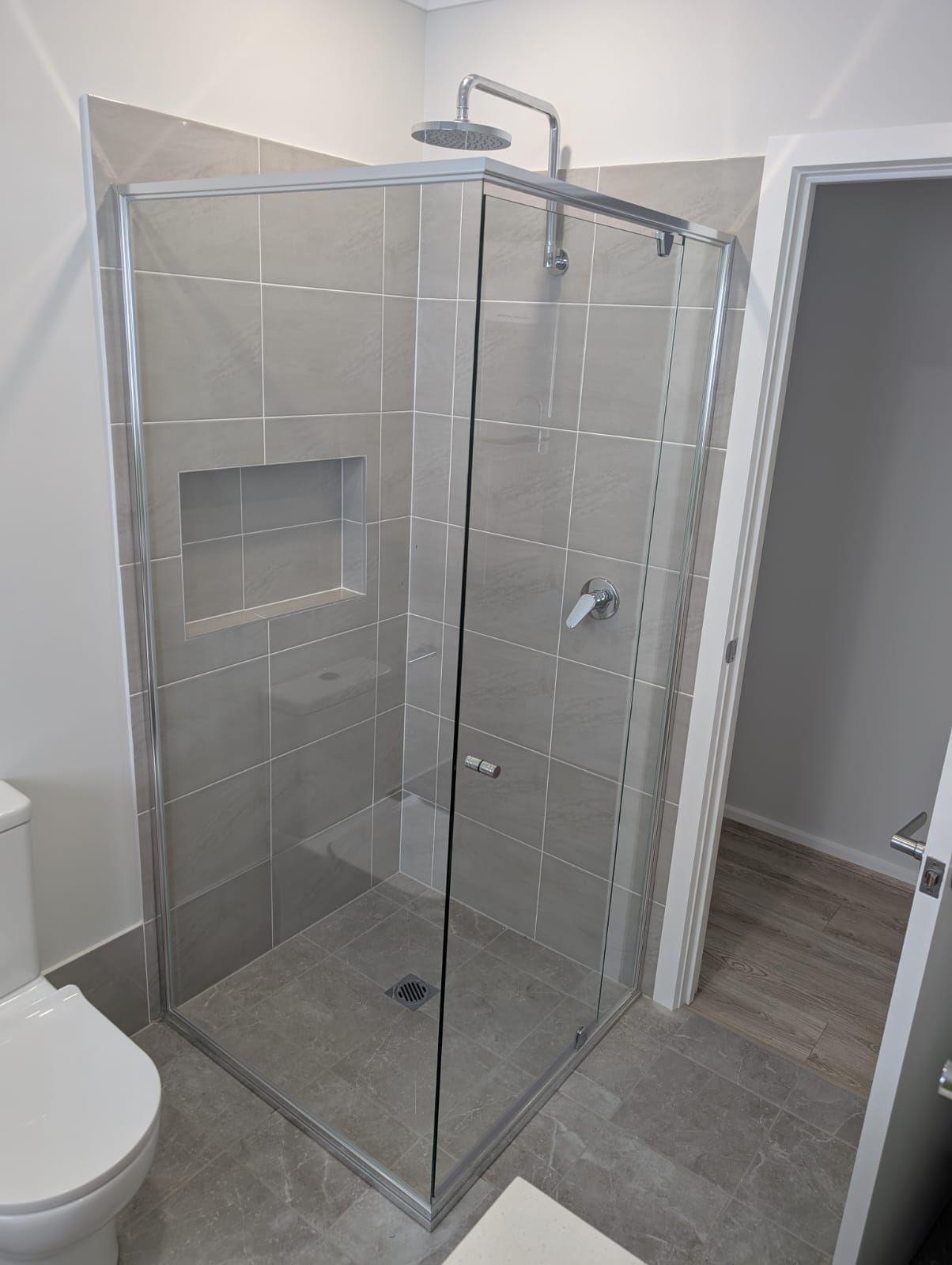
Frameless vs semi-frameless vs framed: choosing a shower screen
The three names describe one thing — how much aluminium is holding the glass — and the right answer usually comes from the shape of your bathroom rather than the look you like best.
Framed, semi-frameless and frameless are the same idea in three amounts: how much aluminium holds the glass. A framed screen has aluminium around every edge of every panel. A semi-frameless screen keeps a frame on the fixed panels but leaves the door edges bare. A frameless screen has no frame at all — thick toughened panels held by brackets and hinges. All three are made to measure, all three use safety glass, and all three will keep water in a shower that is set up for them. The choice is mostly about the room: how square the walls are, how much space the door needs, and what sits behind the tiles.
What actually separates the three
The frame is not decoration. In a framed screen the aluminium channel supports the glass along its whole length, which is why a framed screen tolerates walls that are out of plumb — the channel takes up the gap. Take the frame away and the glass has to do that work itself, so a frameless panel is thicker, heavier and far less forgiving of a wall that leans. Semi-frameless sits in between: the fixed panels are framed and the door is not, so you get a cleaner line without asking the whole screen to be self-supporting.
Framed shower screens
A framed screen is the most forgiving option, and in an older bathroom that is a real advantage. The frame hides the gap where a wall is not plumb, the channel carries the glass, and a framed screen can run a sliding door — which matters when there is no room for a door to swing.
The trade-off is upkeep. More frame means more tracks, more sealed joints and more places for soap and water to sit. If the bathroom is tight, or the walls are nowhere near square, a framed shower screen is usually the sensible answer.
Semi-frameless shower screens
Semi-frameless keeps a slim frame on the fixed panels and leaves the door edges polished and exposed. There are fewer tracks than a fully framed screen and more tolerance than a frameless one, so it suits the common case: a bathroom where the walls are reasonable but not perfect.
The door is usually a pivot rather than a slider, so it needs clearance to swing into the room. Check that before anything else — it decides more semi-frameless shower screen jobs than the look does.
Frameless shower screens
Frameless is the plainest to look at and the quickest to wipe down: a flat sheet of glass with no bottom channel for dirt to collect in. It also asks the most of the bathroom.
- Solid fixing points behind the tiles — studs, noggings or masonry — because the hardware carries the weight of the glass
- Walls close to square and plumb, since any lean shows up as an uneven gap
- Floor clearance for a door that swings outwards
- A floor fall or shower base that keeps water in without a bottom channel
Where the room can take it, a frameless shower screen is the least cluttered and the least work to keep clean.
Whichever style you pick, the glass is safety glass
Bathroom glazing is covered by the National Construction Code. Clause 8.4.6 of the NCC Housing Provisions, Part 8.4 covers all glazing in kitchens, bathrooms, ensuites and the like — including shower doors, shower screens and bath enclosures — where the lowest sight line is less than 2.0 m above the floor, the bottom of the bath or the shower base. Framed panels must be glazed with Grade A safety glazing material. Panels or doors with any edge exposed must be toughened safety glass with a minimum nominal thickness of 6 mm.
That is the practical reason a frameless door is thicker than the glass in a framed screen: its edges are exposed, so the standard sets a floor under the thickness. We install safety glass that meets AS/NZS 2208 and glaze to AS 1288. This is general information only — a glazier can confirm what the standard requires for your particular bathroom.
How to decide, in order
- Measure the opening and look at where a door could go. A door with nowhere to swing rules out pivot and hinged frameless doors before style comes into it.
- Check how square the room is. Hold a level against the walls and across the base. A visible lean points to framed or semi-frameless.
- Decide the door type. Sliding for tight rooms, pivot for average ones, or a fixed walk-in panel with no door at all.
- Find out what is behind the tiles. Frameless hardware needs something solid to fix into.
- Choose the finish last. The colour is the easy part, and it does not change what the opening will take.
Cleaning and upkeep, honestly
No shower screen is maintenance-free. Glass shows water marks in all three styles, and a squeegee after a shower does more than any cleaner. What differs is how many places dirt can hide — framed screens have tracks and more sealed joints, semi-frameless has fewer, frameless has almost none.
Seals and hardware wear out whatever the style. Door seals go brittle, pivot blocks loosen and rollers wear on sliding doors. A lot of that is repairable without replacing the screen, which is worth checking before assuming a leaking screen has to come out.
Frame colours and finishes
Frames and hardware come in four standard colours at the standard price: polished silver (chrome), matt silver, white and black. Other colours and finishes, such as brushed brass, are available, price on application.
Frameless screens have a finish to choose too: the hinges, clamps and handle are all on show.
Common questions
Is frameless glass stronger than framed glass?
Not in the way the question usually means. Frameless panels are thicker because the standard requires it where edges are exposed. But a framed screen is safety glass as well, and the frame supports it along its length. Neither is fragile when properly installed.
Does a frameless screen leak more?
It can, if the bathroom is not set up for one. With no bottom channel, the fall of the floor and the position of the shower rose do the work of keeping water in. In a bathroom built for one that is not a problem; where water already pools near the entry, a framed or semi-frameless screen with a bottom channel is safer.
Which style suits a shower over a bath?
All three are made for bath enclosures, and the deciding factor is normally the swing. A hinged or pivot panel has to clear the bath edge, so a fixed panel or a sliding arrangement is common.
Can I have a screen with no door at all?
Yes. A single fixed walk-in panel is one of the most common frameless jobs. It needs enough width that the open end sits well away from the shower rose, and the floor has to fall the right way.
Get a measure and quote
All Purpose Glass is a family-owned glazier working from our own workshop in Minchinbury since 1992. We measure, make and install framed, semi-frameless and frameless shower screens, and our vans run across Western Sydney — Blacktown, Parramatta, Penrith and Fairfield — every weekday. The measure and quote are free within our service area, and the written quote is the price you pay.