
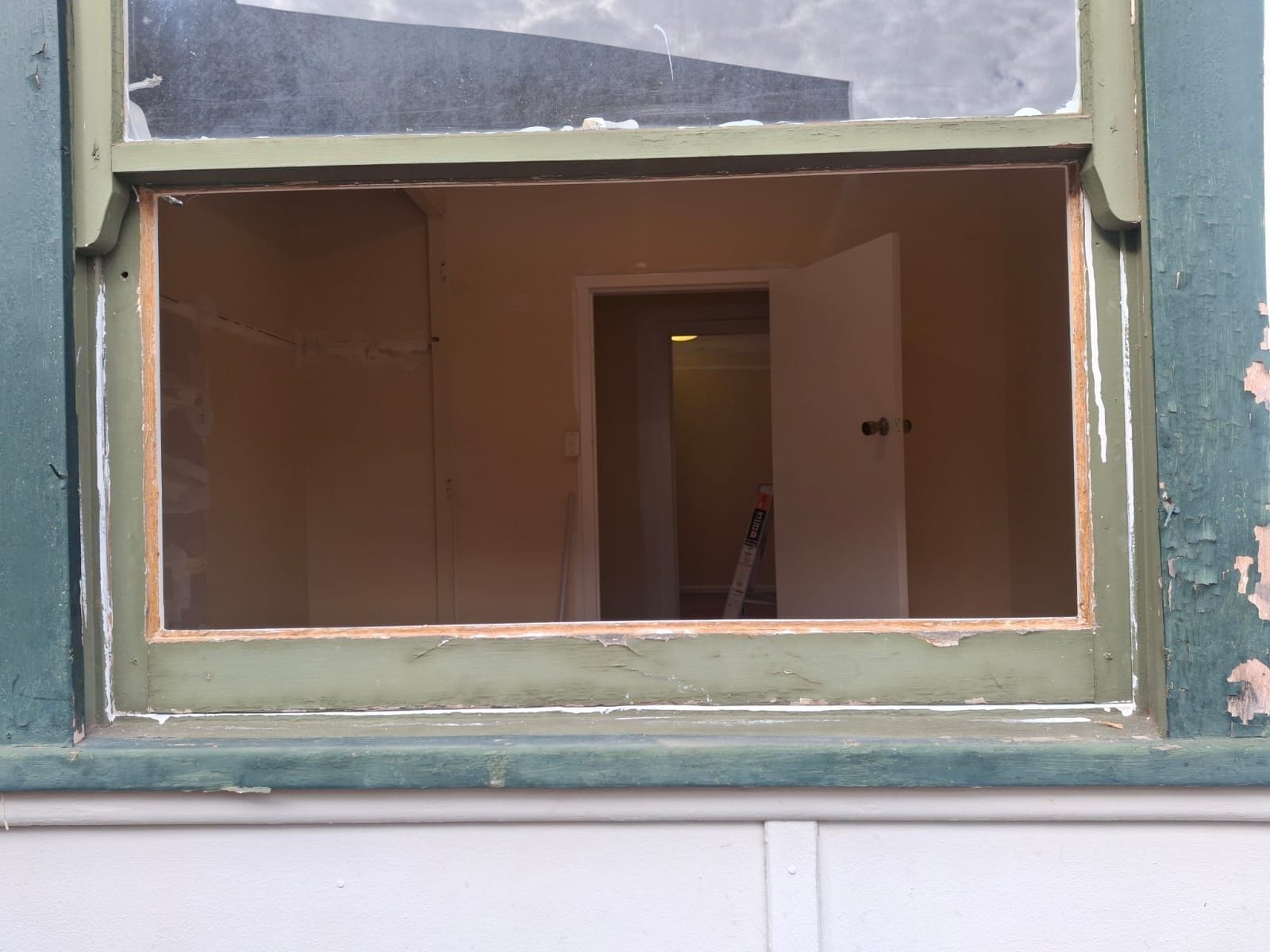
How to measure for glass or mirror cut to size
Measure the opening rather than the piece that came out, work in millimetres, and say whether your figure is the opening or the finished glass.
Cut to size means exactly that: the glass or mirror is cut to the figures you give us. Get them right and the piece drops straight in. Get them wrong and you have paid for something that does not fit, because glass cannot be put back on once it is off. So measure the opening rather than the old pane, in more than one place, in millimetres, and make clear whether your number is the opening or the finished size.
Measure the opening, not the glass that came out
The old pane is the wrong thing to copy. It may have been cut badly when it was made, the edges may have chipped on the way out, and a cracked piece can spread a millimetre or two before it comes free. The frame is what the new glass has to live in, so the frame is what gets measured. If the glass is still in place, measure the visible opening and tell us that is a glazed-in figure — there is more glass hidden under the putty or bead than you can see. If the frame is already empty, measure tight into the rebate, right into the corners.
How to measure, step by step
- Work in millimetres. Every glazier does. Centimetres get rounded, and rounding is how a pane ends up 5mm too big.
- Take the width in three places — top, middle and bottom. Then the height in three places — left, middle and right.
- Write down the smallest of each. Frames are rarely straight, and the glass has to pass the tightest point to get in.
- Check it is square. Measure both diagonals. If they differ by more than a few millimetres, a plain rectangle will not sit in the opening neatly — say so when you order, or make a template.
- Say what the figure is. Tell us it is the opening or rebate size, or the finished glass size you want. We allow clearance so the piece can go in and move slightly with the frame — if you take that clearance off as well, the glass ends up loose.
- Measure the thickness at an exposed edge with a ruler, or bring the broken piece with you.
- Template anything that is not a plain rectangle. For curves, a notch around a bracket, or holes for handles and fixings, make a full-size template from cardboard, mark which face is the front, and mark the hole centres.
- Check the route. A large mirror has to get through the doorway, along the hall and around the turn in the stairs. Measure the tightest point before you order.
Thickness: how to work out what you need
Thickness is part of the order, not a detail to sort out later. Thin glass in a large opening flexes, and flexing is what breaks it, so the size of the piece and the way it is supported both feed into the right thickness. Small sash panes and cabinet doors sit at the thin end, mirrors in the middle, and shelves, tabletops and large panels go thicker.
The simplest way to get it right is to measure the edge of the old piece, or bring it in to be matched. For a window or a door, a glazier can confirm what the standard requires for that opening.
Edges: ask for the finish you need
An edge cannot be changed once you have taken the glass home.
- Clean cut or arrised — for glass that disappears into a frame, rebate or channel. It is sharp, so not for anything you will handle.
- Flat ground — dulled and squared off. Safer to handle, still utilitarian.
- Polished — smooth and clear. The finish for mirrors, shelves and tabletops, where the edge is on show.
- Bevelled — a wide angled border around the face, mostly used on mirrors for decoration.
If an edge will be seen or touched, ask for it polished when you place the order.
What cannot be cut to size
Toughened glass cannot be cut, drilled or trimmed after it has been toughened. It is cut and worked first and toughened afterwards, so every hole, notch and cut-out has to be decided before the piece is made. Double-glazed units and shower screen panels are made to size for the same reason. A toughened panel that is 5mm too wide is not a trim job — it is a new panel.
The second limit is where safety glass is required: ordinary float glass cut to size is not a substitute. AS 1288, the Australian Standard for the selection and installation of glass in buildings, covers glass selection, installation and human impact safety, which is what usually applies to glazing in and beside doors, low-level windows, bathrooms, shower screens and balustrades. What it requires varies with the opening, so a glazier can confirm what the standard calls for in your case. We install safety glass that meets AS/NZS 2208 and glaze to AS 1288.
Collecting it from the workshop
Glass and mirror cut to size is supply only, collected from our workshop in Minchinbury. A few things are worth sorting out first.
- Carry glass on edge and upright, never flat. Flat glass flexes across the middle, and that is what cracks it.
- Bring gloves, and a blanket or packing foam to keep the faces off anything hard.
- Stand a long piece upright against the back of a seat and wedge it so it cannot slide or tip.
If you would rather not handle it at all, replacing the glass in a window or door is a job we do on site — see glass replacement across Western Sydney.
Common questions
Can you cut toughened glass to size?
No. Once glass has been toughened it cannot be cut, drilled or edge-worked, and attempting it shatters the panel. Toughened pieces are cut and finished first and toughened after, so the final size and any holes have to be settled up front.
How accurate do my measurements have to be?
To the millimetre. We cut to the figures you give us, so if the measurement is out, the glass is out by the same amount, and it cannot be corrected afterwards. If there is any doubt — an out-of-square opening, an awkward shape, or a size you cannot reach safely — ask for a free measure instead.
Can mirror be cut to size with a polished edge?
Yes. Mirror is cut the same way plain glass is, and the edges can be finished so they are safe and tidy where they will be seen. Tell us the finish you want, and mark any holes or notches on a full-size template.
Do I have to collect it, or can you install it?
Cut to size is supply only, collected from the workshop. If you would rather the glass was fitted, that is a glass replacement job: we measure, make and install, with a free measure and quote within our service area.
Get your glass or mirror cut
All Purpose Glass is a family-owned glazier working from our own workshop in Minchinbury since 1992. We cut glass and mirror to size for collection, make custom mirrors to measure, and install glass across the Blacktown, Parramatta, Penrith and Fairfield areas, including Seven Hills. Bring your measurements, or ask for a free measure.