
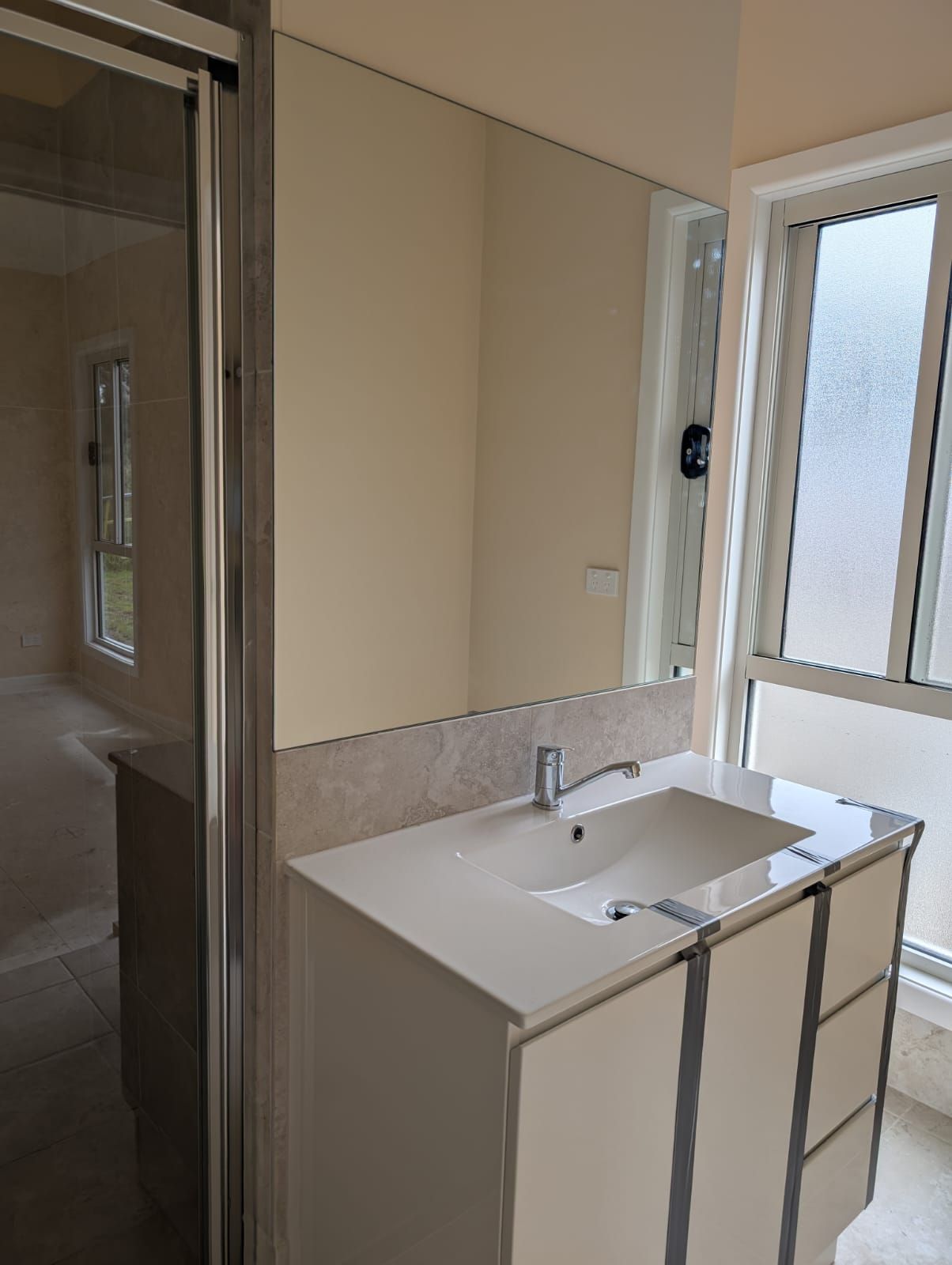
Bathroom mirror installation: what to decide first
Fitting the mirror is the quick part — the decisions that matter are the size, the edge finish, the backing and how it is held to the wall, and all of them have to be made before the glass is cut.
A bathroom mirror that suits its space is a made-to-measure item, and fitting it is usually the shortest part of the job. What takes thought is everything decided beforehand: how big it is, where it sits, what the edges look like, and how it will be held onto a tiled wall. Those choices get made once, because the glass is cut to them.
Start with the wall, not the mirror
The wall decides more than people expect. Tiles are the common case in a bathroom, and drilling through a tile to take a screw or a clip risks cracking it, so mirrors on tiled walls are often bonded on instead. Plasterboard will not hold a heavy mirror on adhesive alone without something solid behind it.
Look at what is in the way, too: the light above the vanity, power points, a recessed shaving cabinet, the tile joins you would rather not cut across. A mirror that stops neatly at a tile line looks deliberate; one that overlaps a join looks like a mistake nobody can fix afterwards.
Size and placement
The usual starting point above a vanity is a mirror a little narrower than the vanity top, centred on the basin rather than on the wall, since basins are often slightly off-centre. Height is about who uses it: the mirror needs to cover eye level for the shortest and tallest people in the house, which usually means taller rather than wider.
Measure the opening you want filled, not the mirror you imagine, and measure it in more than one place — bathroom walls are rarely square. Our guide on how to measure for glass or mirror cut to size covers taking the sizes and what tolerance to allow.
Edges, thickness and frames
A frameless mirror has to have its edges finished, because a raw cut edge is sharp and looks unfinished. A polished edge is smooth and squared off and reads as modern. A bevelled edge, where a band around the perimeter is ground back at an angle, catches the light and makes a plain rectangle a feature.
A frame hides the edge, gives you something to match to tapware or a shower screen, and can cover a slightly uneven wall line. Mirrors also come in a few standard thicknesses, and a large mirror is better made in the thicker one — a big thin mirror can show a faint waviness in the reflection once it is up.
Backing, moisture and safety
The reflective layer sits on the back of the glass under a protective coating, and in a bathroom the back edge is what fails first. The dark marks creeping in from the edge of an old mirror are the backing breaking down where water has sat against it. Three things make that less likely:
- A bathroom that actually ventilates — an exhaust fan that gets used, or a window that opens.
- Spraying cleaner onto the cloth rather than onto the mirror, so it does not run down and pool along the bottom edge.
- The right adhesive. Some ordinary silicones and construction adhesives attack mirror backing, which is why a mirror should be bonded with a product made for mirrors.
Mirrors can also be supplied with a safety backing — a film bonded to the back that holds the pieces together if the glass breaks. Ask whether that is included or an option, particularly for a large mirror, one in a bathroom used by children, or one over a hard floor.
How a mirror is fixed to the wall
The sequence on a typical made-to-measure bathroom mirror runs like this:
- The wall is finished first — tiles on, vanity in, light fitted — and only then measured, so the mirror is cut to the room as built.
- The mirror is made to size, with the chosen edge finish and any cut-outs done at the same time. Holes and notches cannot be added later.
- The wall is checked for flat and plumb — a hollow or a bow needs packing, because a mirror bonded onto a high spot sits under tension.
- The fixing suits the wall and the weight: bonded with a mirror-safe adhesive, held in clips, or dropped into a channel.
- The mirror is positioned and supported while the adhesive cures — it has to be held true, not just held up.
- Edges are sealed or finished where needed, and the glass is cleaned down.
Cut-outs are the one to get right: anything that will sit inside the outline of the mirror has to be known at the measure, not discovered on installation day.
Mirror doors are a different job
A mirror on a wall and a mirror that forms part of a door are not the same product. The National Construction Code’s Housing Provisions require glass in doors to be Grade A safety glazing material, and treat framed panels close beside a doorway the same way (NCC Housing Provisions Part 8.4). A glazier can confirm what the standard requires for your particular door. We install safety glass that meets AS/NZS 2208 and glaze to AS 1288.
That is why mirrored sliding wardrobe doors are built as doors, with the mirror held in a frame that runs on a track. If what you want is a full-height mirror on a wardrobe front, say so early — it changes the product, not just the size.
What drives the cost
Mirror pricing comes down to the size, the thickness, the edge finish, how many cut-outs are needed, whether there is a frame, how it is fixed, and how awkward the access is. A plain rectangle with a polished edge over a standard vanity sits at the simple end; a tall bevelled mirror with cut-outs around a light does not. We give a written quote after a free measure, and the written quote is the price you pay.
If you would rather handle the fitting yourself, mirror can also be cut to size and collected from our Minchinbury workshop as a supply-only job.
Common questions
Can an existing mirror be cut down to a smaller size?
Sometimes, if it is a plain mirror with no safety backing and no toughening — but the new edge has to be finished, and the backing can lift along the cut. By the time that is done it is often no cheaper than a mirror made to the size you want. A toughened or safety-backed mirror cannot be cut at all.
Can a mirror go straight onto tiles?
Usually yes, and it is often the better option because it avoids drilling the tiles. What matters is that the tiles are sound and the adhesive is one made for mirrors. A loose tile has to be sorted out first.
Does the bathroom have to be finished before you measure?
For a mirror sitting in a recess or butting up to tiles, yes. Tile thickness and the position of the vanity move the opening by enough to matter, and a mirror cut to the plan rather than the finished room is the usual reason one does not fit.
Need a mirror made to fit?
All Purpose Glass is a family-owned glazier working from our own workshop in Minchinbury since 1992. We measure, make and install custom mirrors for bathrooms, hallways and wardrobes, and our vans run across Western Sydney — Blacktown, Parramatta, Penrith and Fairfield — every weekday. The measure and quote are free within our service area, and the written quote is the price you pay.